 |
| Wind action (Extract from UNE instruction 85-2220-86).
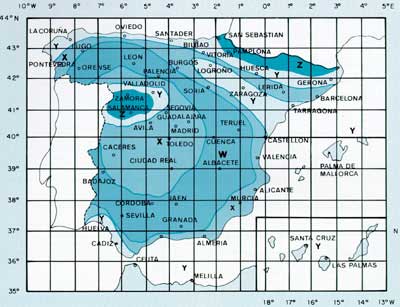
Value of wind action. Wind action exerts pressure, its value being proportional to the square of velocity. With respect to the wind resistance of windows, the pressure figure w is obtained from the basic pressure, a coefficient of location/height and a coefficient of pressure/suction. Basic wind pressure. Basic wind pressure may be defined as that produced by average wind velocity as measured at intervals of 10 minutes at a height of 10 metres on open and flat ground, and whose value is not surpassed in fifty years. Its value may be obtained as a function of the geographical location of construction.(table 1). |
| Table 1 Basic wind pressure |
| Area according to map 1 | w | x | y | z |
| Basic velocity (m/s) Basic pressure (Kp/m²) (Pa) |
22 30 296 |
24 36 352 |
26 42 414 |
28 49 480 |
 |
| Table 2 Location / height coefficient |
| Location of building | Height of window above ground level in metres | |||||
| 3 | 5 | 10 | 20 | 30 | 50 | |
| Centre of a large city | 1,63 | 1,63 | 1,63 | 1,63 | 1,68 | 2,15 |
| Urban areas | 1,63 | 1,63 | 1,63 | 1,96 | 2,32 | 2,82 |
| Rural areas | 1,63 | 1,63 | 1,89 | 2,42 | 2,75 | 3,20 |
| Open ground with no obstacles | 1,64 | 1,93 | 2,35 | 2,81 | 3,09 | 3,47 |
| Windows in highly exposed facades, such as those next to a steep drop, the open sea or a large lake, would require special study. | ||||||
|
Pressure/suction coefficient The pressure/suction coefficient depends on the shape and size of the building, on the location of the window in the facade, such as under the eaves or at a corner, and on the degree of exposure of the building. In order to provide a simple summary of all possibilities, the following values of the said coefficient will be used: a) Windows in interior patios of a width lower than the height of the building and unconnected to exterior space in its lowest section; interior windows when double:..........0,3. b) Windows in protected facades in aligned buildings in straight streets at a distance from the corner which is greater than the height of the building; in open blocks in the central part of a facade longer than double its height and in patios with open facades or patios in city blocks:..........0,8. c) Windows in exposed facades in isolated buildings, in facades whose length is less than double their height: ..........1,3. NOTE.- In areas close to steep slopes, lake or sea shores, on a steep hillside, inside a deep, narrow valley or in a narrow pass, the wind velocity in predominant directions may multiply by a factor of up to 1.5 and consequently the pressure may increase by up to 2.25 times that considered to fall within the above-mentioned values. In such cases the builder should adopt a prudent correcting coefficient. |
 |